
John Gray: The Last Living Revolutionary Veteran, Buried in Ohio
By Pamela Shafer, Noble County Historical Society, March 2026.
Ohio’s Revolutionary Legacy: A Final Resting Place for 7,000
Did you know Ohio has more Revolutionary War veterans buried here in the “Buckeye State” than almost any other state in the Union? An estimated 7,000 veterans of the Revolution have been documented to have called Ohio not only their home, but their final resting place. Noble County serves as the resting place for at least 61 of these patriots.
Who Was John Gray? The Last Living Link to the American Revolution
John Gray, who lived to the ripe old age of 104, is one of these veterans of the Revolution. Upon his death on March 29, 1868, he was the last verified surviving veteran of the American Revolution.
From a Virginia Plantation to the Battle of Yorktown
Born Jan. 6, 1764 near Mt. Vernon, Fairfax Co., VA., John was the oldest child of Irish immigrants. His father was killed in the Revolution at the Battle of White Plains, NY, shortly after enlistment while John was 13. In a poor family of 8 children, sometimes having nothing to eat but a rabbit that he and his dog hunted, John labored on the plantation of George Washington to support his family.
At the age of 16, he picked up the musket that had fallen from his father’s hands and joined the Virginia militia in 1780. He began at Fairfax and went to Fredericksburg, from there to Yorktown, Richmond and Williamsburg, being present at the surrender of Cornwallis to Washington at Yorktown.

Washington’s Last Companion: A Personal Connection to the General
Following the war, he returned to work for George Washington. Located on Dog Run stream was a water-powered sawmill where John labored with whipsaws alongside Washington’s slaves. One day, who should ride up but George Washington, who called to John as he knew him well. John dropped his saw to shake the General’s hand, who inquired fondly about John’s health, bade goodbye and rode away. John enjoyed relaying his experience and has been referred to as “Washington’s Last Companion”.
A Pioneer’s Journey: From the Virginia Frontier to Noble County, Ohio
In 1784, John married Nancy McDowell and moved to Morgantown, Va. Because John was not a property owner, he was not allowed to vote. He fought for the freedoms of a country and wanted to partake in its freedoms. Having a notion to go to Kentucky, he built a boat to carry his family and horses and went down as far as Dilles Bottom where he resided nine years and from there to Fish Creek, where he leased land to clear and stayed seven years. During the Indian wars, John Gray encountered a few and recalled that the settlement was sorely afraid following “Mad Anthony” Wayne’s defeat in 1794. He admittedly fired upon one or two “redskins”. John united with Nancy Ragan at Flats of Grave Creek (near Moundsville, WV).
A saltlick on Duck Creek served as a hunting ground during winter and John eventually settled near the present site of Hiramsburg, OH in 1829. Here, he married Catherine Bond, a widow with three daughters.
The Man Behind the Legend: A Portrait of John Gray
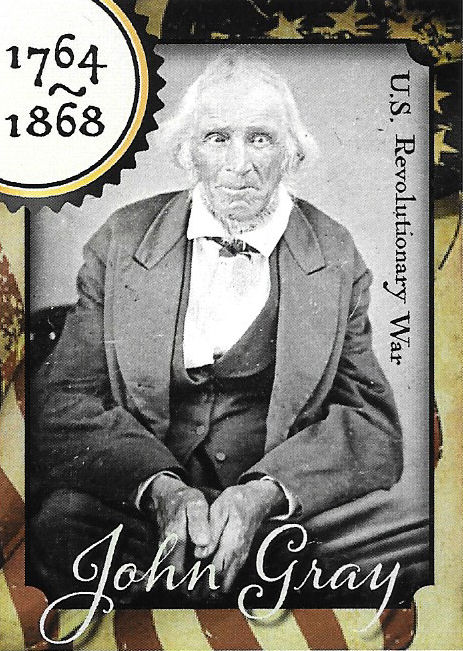
John Gray has been described in as 5’8” with a huge chest, a massive head of perfect symmetry, feet as small as a woman’s, having long hair and large hands with rugged features and deep set blue eyes. “He was not ugly. His smile made him look handsome. His voice trembled a little but was pleasant; a subdued and musical treble like that of a child,” stated Pvt. James M. Dalzell. Gray was both thoughtful and reflective. Advancing in age, his hearing and sight failing, so old he walked with two canes, he was a man of simple faith and an avid Bible reader.

A Century of Resilience: Poverty, Health, and a Late Pension
In 1866, Washington County news reported that John Gray never received one farthing from his government in the shape of land warrant, pension, etc. His last years were spent entirely dependent on the charities of a step-daughter, yet he enjoyed remarkably good health and good mental faculties for a person of advanced age. He had never taken medicine from a physician in his life. At the age of 102, Gray was approved for pension under a special act of Congress (H. R. 1044) dated Feb. 22, 1867. He is seen in pension ledgers on March 29, 1868 with a half-year provision of $250 to sustain him.
John resided in a humble one-story, hewed-log cabin. He was a hardworking man but remained poor his entire life. John recanted through a merry laugh, “I sometimes have had nothing but a dog,” musing “…and a plug of tobacco, of course, for without a dog or tobacco I should feel lost.” John had chewed tobacco 100 years and knew its virtues in solace.

Preserving History: The First Photograph of a 102-Year-Old Veteran
What John lacked in worldly goods, he could take pride in his longevity. Although there exist earlier sketches, John lived to see the invention of photography and had his first picture taken at age 102 when family and Pvt. Dalzell eagerly arranged to preserve his likeness for Frank Leslie’s Illustrated Newspaper and Congress.
The Final Muster: The Death and Burial of an American Hero
As word circulated that John Gray was ill, neighborhood teens, Cy Scott and his friend went to offer assistance, walking through snow in a cold March wind. Finding him near-death, they walked a mile further to notify Mr. Gray’s relatives. Eli Thompson, a Hiramsburg carpenter, was approached to construct a black walnut coffin for the local hero. Cy was asked to hitch his father’s horses to a sled and haul the coffin from Mr. Gray’s home to the grave, about an eighth of a mile distance. John Gray was laid to rest in the family graveyard beside his wife, interred near relatives Samuel Halley (War of 1812) and Gillespie David (Revolutionary).
Despite the cold weather, more than a thousand people arrived to witness the old patriot being escorted from his simple log cabin to the McElroy family burial grounds. John was 104 years, 2 months, and 21 days when he took his last breath on March 29, 1868. He had outlived three wives, saw the birth of our nation, weathered all of its early hardships as well as its triumphs and rebirths.
His will bequeathed all he had to his step-daughter, Nancy McElroy, for the compensation of his care. The will states: “In the name of the benevolent Father of all, I, John Gray, of the county of Noble, and State of Ohio, being now in the 104th year of my age, of sound mind and memory, though my limbs are feeble, and I am the last survivor of the Revolutionary War…”
Honoring John Gray: Where to Find His Memorials in Noble County
His burial location at McElroy’s family cemetery displays his original weathered gravestone, a military monument, and a replacement stone. A replica was dedicated at The State Roadside Park on SR 821 in 1956, and military marker is located on the west side of the Noble County courthouse in Caldwell. There is also a painting of him on the third floor of the Courthouse.

References:
Ledgers of Payments to Pensioners
Cambridge Jeffersonian, May 29, 1934
The Ohio Historical Review Featuring Noble & Washington Counties, Vol. 1, No. 36
Noble County Chapter OGS newsletter 1988 P 15-16
The Plain Dealer, May 25, 1987 P 8-B by Richard Ellers
Cambridge Jeffersonian, June 26, 1934
Noble County History, 1887 by Watkins
Pension file No S-1464
Research of Lois Blake, 1988
Obituary of John Gray, 1868
Washington County News, May 29, 1866
The Journal, Caldwell OH – July 30, 1953 Article by Samuel Stille
Pvt. James M. Dalzell – Autobiography, Poems, and Comic War Papers, 1888
Will of John Gray, Apr 22, 1868, Brookfield Twp, Noble Cty, OH. Book I, page 379
Alan Hall article in the Parkersburg News & Sentinel, 2021