Fort Meigs: The Battleground for Democracy
Written by Meryl Wittmer, American Battlefield Trust’s Youth Leadership Team, November 2025
Time does not freeze for a battlefield when troops march off it for the last time. Remembering what happened there is important not only for those who served, but for the land itself. For these battlefields, the fight never ends…it just changes form.
Fort Meigs was a crucial site during the War of 1812, the second fight for American Independence. Years later, it was the setting for a different kind of fight: this time, the exercise of free speech during a presidential campaign.
Fort Meigs and The Second War for American Independence
During the War of 1812, America found herself in an all too familiar situation. Peaceful harmony came to an abrupt halt as (once again) our new nation fought against the British and their Native American allies.
William Henry Harrison, the commander of the Army of the Northwest, commissioned the building of Fort Meigs in what would later become Perrysburg in response to attacks in the Northwest. Immediately, troops persevered through harsh winter snows, sinking mud, and disease, until the completion of the fort in April, 1813.

Victory only lasted two short months. The British returned, this time with a clever plan to stage a false attack and lure American troops away from the fort. Major General Green Clay refused to abandon his station, and a well-timed storm put an end to the British and Native American attempt, once again producing an American triumph. Soon thereafter, Fort Meigs was reduced in scale, and ended its service as a depot for supplies.
A Presidential and First Amendment Battle
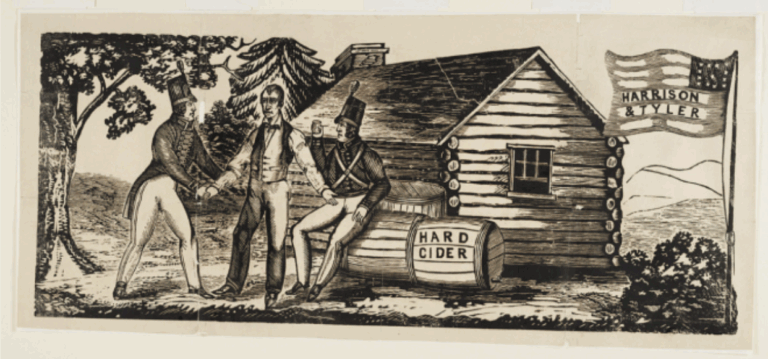
After the war of 1812, William Henry Harrison crossed paths with Fort Meigs again. In 1840, Harrison was campaigning for the presidency with the Whig party under the slogan, “Tippecanoe and Tyler Too”. The campaign prominently featured log cabins, appealing to the working class and suggesting that Harrison had humble beginnings. In reality, Harrison was a well-educated aristocrat.
Five years prior, a small political group known as the Equal Rights Party had emerged from New York. They advocated for democracy as a method of defending natural rights, and they opposed monopolies and anti-democratic policies, especially in the financial world. The Equal Rights Party was a natural opponent of Harrison’s Whig policies and his aristocratic priorities. The Equal Rights Party attacked Whigs politically, and Whigs responded by dehumanizing The Equal Rights Party through propaganda depicting them as beastly and crude, giving them the derogatory nickname “locofocos.”
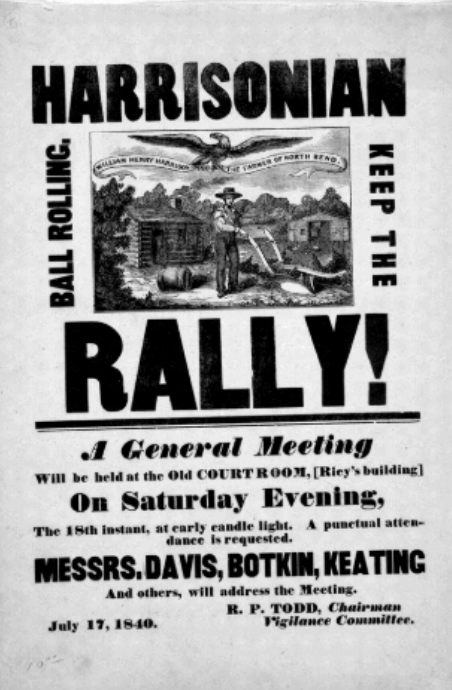
It was announced that on June 11, Harrison would return to Fort Meigs for a rally. Harrison’s campaign asked every township in Ohio to provide a log to build a log cabin on site. The Equal Rights Party was angered by what they saw as a blatant manipulation of working-class people through humble imagery, and they decided that something had to be done.
Under the cover of the night, a local coalition of the Equal Rights Party gathered at Fort Meigs. They collectively lifted a heavy log that had been intended for Harrison’s Cabin and deposited it in a dried-up well. The simple act caused no harm and served only as a symbol of the party’s disapproval. In response to this, the Whigs simply mocked the futility and low impact of the protest.
The rally continued as scheduled, and estimated attendance reached 50,000 people. Harrison went on to have a successful campaign, and was elected the 9th president of the United States. Unfortunately, Harrison died of pneumonia shortly after taking office. Not long after, the Whig party lost political traction and was dissolved. Some Whigs went on to unite with the Equal Rights Party to form the 1848 Free Soil Campaign, an anti-slavery movement.
Ironically, the log that the Equal Rights Party had deposited in the well remained in place far after the two parties dissipated. A 1975 newspaper, The Perrisburg Messenger-Journal, cites the existence of the log, still wedged into the well, over a century later. Today, it’s on exhibit in the on-site museum.
After an intense existence as a literal battlefield, Fort Meigs served as a presidential and free speech battlefield years later. Like the log in the well, ideas far outlive any person or group as time drifts on. The fight for political ideals and the freedom to speak one’s mind continued past the Equal Rights Party, and it continues today.
Works Cited
“A History of Fort Meigs.” Fort Meigs, fortmeigs.org/a-history-of-fort-meigs/. Accessed 2 Nov. 2025.
“Second Fort Meigs.” American Battlefield Trust,
www.battlefields.org/learn/war-1812/battles/second-fort-meigs. Accessed 2 Nov. 2025.
“Seige of Fort Meigs”, D.W. Kellogg & Co., 1845.
Swartz, Marie. “Locofoco Meanness at Fort Meigs.” Ohio History Connection, 9 June 2025,
www.ohiohistory.org/locofoco-meanness-at-fort-meigs/.
“‘Harrison & Tyler’ Campaign Emblem.”, 1840
“Harrisonian Rally! .”, 1840
Henry Dacre, Specie Claws (New York: Henry Robinson, [1837?]).
The Editors of Encyclopaedia Britannica. “Locofoco Party”. Encyclopedia Britannica, 26 Feb. 2018,
https://www.britannica.com/topic/Locofoco-Party. Accessed 2 November 2025.
“The Loco-Foco Declaration of Principals.” Libertarianism.Org,
www.libertarianism.org/media/classics-liberty/loco-foco-declaration-principles. Accessed 2 Nov. 2025.
Widmer, Ted. “Barnburners and Locofocos.” The Walt Whitman Archive. Gen. ed. Matt Cohen, Ed Folsom, & Kenneth M. Price. Accessed 02 November 2025. <http://www.whitmanarchive.org>