
Ohio’s Legacy of Leadership in Blind Education
By Eric Duffy, Accessibility Coordinator at Opportunities for Ohioans with Disabilities. Eric is currently serving on the America 250-Ohio Undertold Stories Committee.
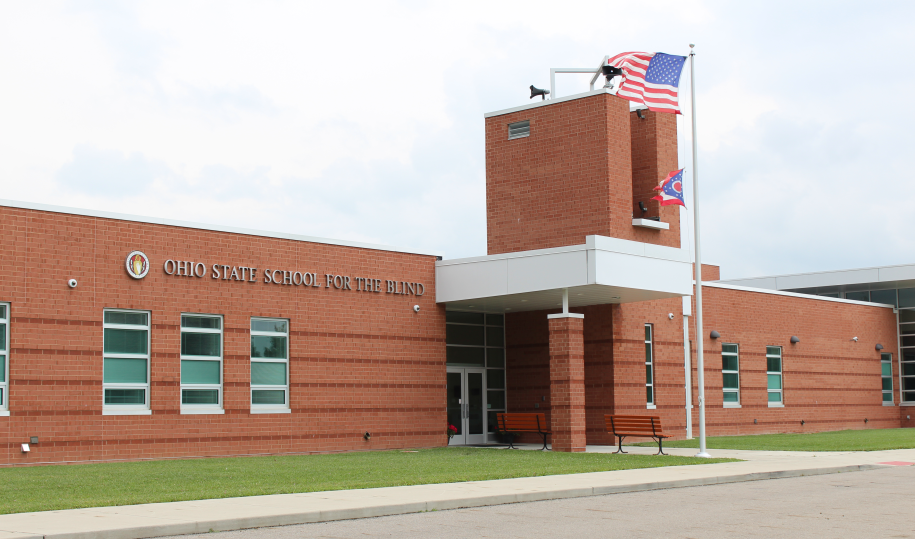
Often when people think about the education of blind or low vision children, the name Helen Keller comes to mind. Her remarkable journey, made famous through books and film, is closely associated with the Perkins School for the Blind in Massachusetts, where she was educated. But many don’t realize that Ohio was home to the nation’s first publicly funded school for blind students, making it a true pioneer in accessible education.
This bold and compassionate commitment began in 1837, when the Ohio Institution for the Education of the Blind was established in downtown Columbus. At a time when most children with disabilities were excluded from formal education, Ohio took a groundbreaking step. That first year, 11 students enrolled. Just two years later, in 1839, the first dedicated school building was constructed, with space for up to 60 students.
As the need for services grew, so did the school. By 1874, the institution expanded to accommodate more than 300 students. In the early 1900s, it became known as the Ohio State School for the Blind (OSSB) and was placed under the authority of the Ohio Department of Education. The original building at 240 Parsons Avenue later served as the headquarters for the Ohio State Highway Patrol and now houses Columbus Public Health.
In 1953, the school moved to its current location at 5220 North High Street, on land that was formerly a golf course. The new campus became known as the “new school,” while the original downtown location was referred to as the “old school.” Adjacent to the Ohio School for the Deaf, the two schools began sharing some administrative and accounting services in the early 2000s, though their educational programs remain separate. When the Ohio General Assembly appropriated funds to build new facilities for both schools, community input and advocacy helped ensure each retained its distinct identity and specialized focus.
Innovation in Tactile Learning
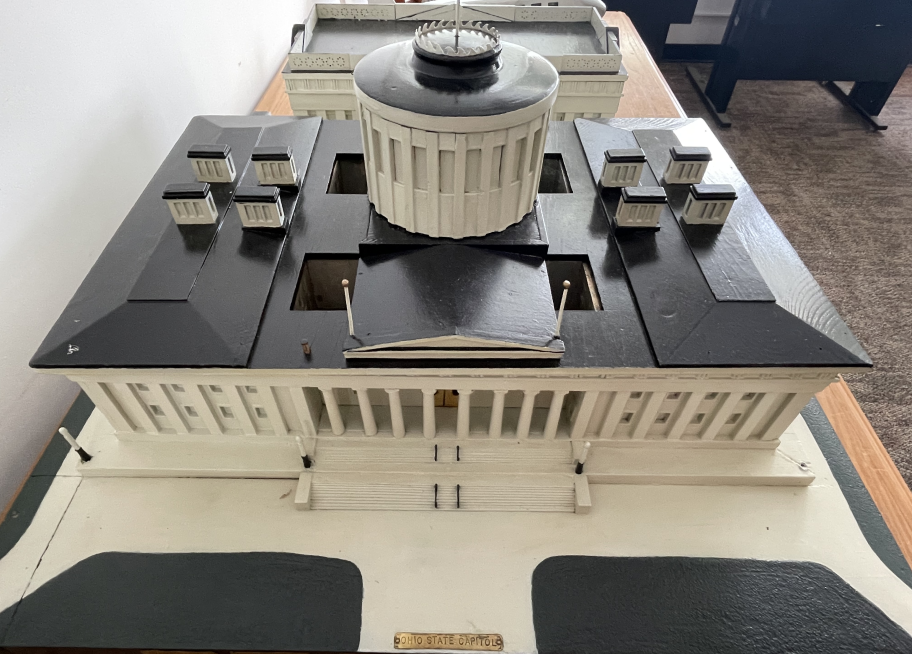
OSSB has long been a leader in tactile education, helping blind students understand the world through touch. In the 1930s, during the Great Depression, the Work Progress Administration (WPA) partnered with the school to create tactile models for classroom use. These models, ranging from the White House to the Taj Mahal, were built to scale and allowed students to explore complex structures and concepts in a hands-on way.
In 1940, then-superintendent William G. Scarberry wrote in a publication titled Models for the Blind:
“Educational models have opened up wider fields of learning for our pupils and have brought into their horizons of conception many objects that before had only vague and fantastic meanings… All of the models made and used at the Ohio State School for the Blind are accurately scaled and complete in every detail; thus, the teacher has no misgivings when she says, ‘Boys and girls, this is the way a Dutch windmill looks.’ She knows it is a true replica.”
— William G. Scarberry
Today, OSSB continues that legacy with advanced 3D printing technology, allowing students and staff to produce detailed models in hours instead of weeks. Although 3D design software is not yet fully accessible to blind users, progress is being made, and students are increasingly involved in the process. Some original WPA models have even been recreated in miniature. A large collection of these tactile models is stored in the school’s basement, with several restored and displayed in the lobby.
Marching to the Beat of Inclusion
In 2010, OSSB’s Marching Panthers made national headlines as the first all-blind marching band to perform in the Tournament of Roses Parade in Pasadena, California. Each student was paired with a sighted marching assistant for visual guidance, but they learned music, routines, and formations like any other band.
Formed in 2005 to support the Ohio School for the Deaf’s football team, the band quickly gained attention with performances like “Script Braille Ohio.” They played at local high schools and even at Ohio Stadium. The Rose Parade invitation marked a milestone, showcasing the talent, determination, and spirit of OSSB students on a national stage.
The Marching Panthers are affectionately known as “The Best Blind Band in the Land.” The band is directed by Yolanda Johnson, with assistance from Jeff Schneider, and has received the National Citation of Excellence from Phi Mu Alpha Sinfonia, a national music fraternity.

A Legacy That Lives On
Since welcoming those first 11 students in 1837, OSSB has continually evolved to meet the changing needs of students who are blind or have low vision across Ohio. While many now attend local schools with support from OSSB’s outreach services and resources, the school remains a vital option for those who benefit from a specialized and individualized education.
OSSB serves students from across the state, offering a comprehensive program that includes academics, life skills, technology training, and extracurricular activities. Through a partnership with Opportunities for Ohioans with Disabilities, Ohio’s vocational rehabilitation program, a dedicated career counselor who is located onsite assists students with disabilities in career exploration, post-secondary planning, work-based learning, paid job experiences, and job coaching.
Today’s students represent a wide range of abilities, and OSSB continues to adapt to support their success. Graduates go on to college, careers, and meaningful roles in their communities.
OSSB also supports statewide education through:
- Braille literacy programs and accessible tools, equipment, and materials
- Professional development for teachers of the visually impaired
- Technical assistance for local school districts
OSSB’s commitment to excellence and innovation is made possible by the continued support of Ohioans, helping generations of blind students to thrive and achieve their goals.
As the alma mater proudly declares:
“A greater school in all the land for us there cannot be, Than this our well beloved one, our own OSSB.”

Eric Duffy is the Accessibility Coordinator at Opportunities for Ohioans with Disabilities, where he supports employers and state agencies in making their digital content accessible to screen reader users. He brings deep expertise from his previous role as Director of Access Technology at the National Federation of the Blind. A long-time advocate for the blind community, Eric is committed to advancing digital inclusion through practical, user-centered solutions.